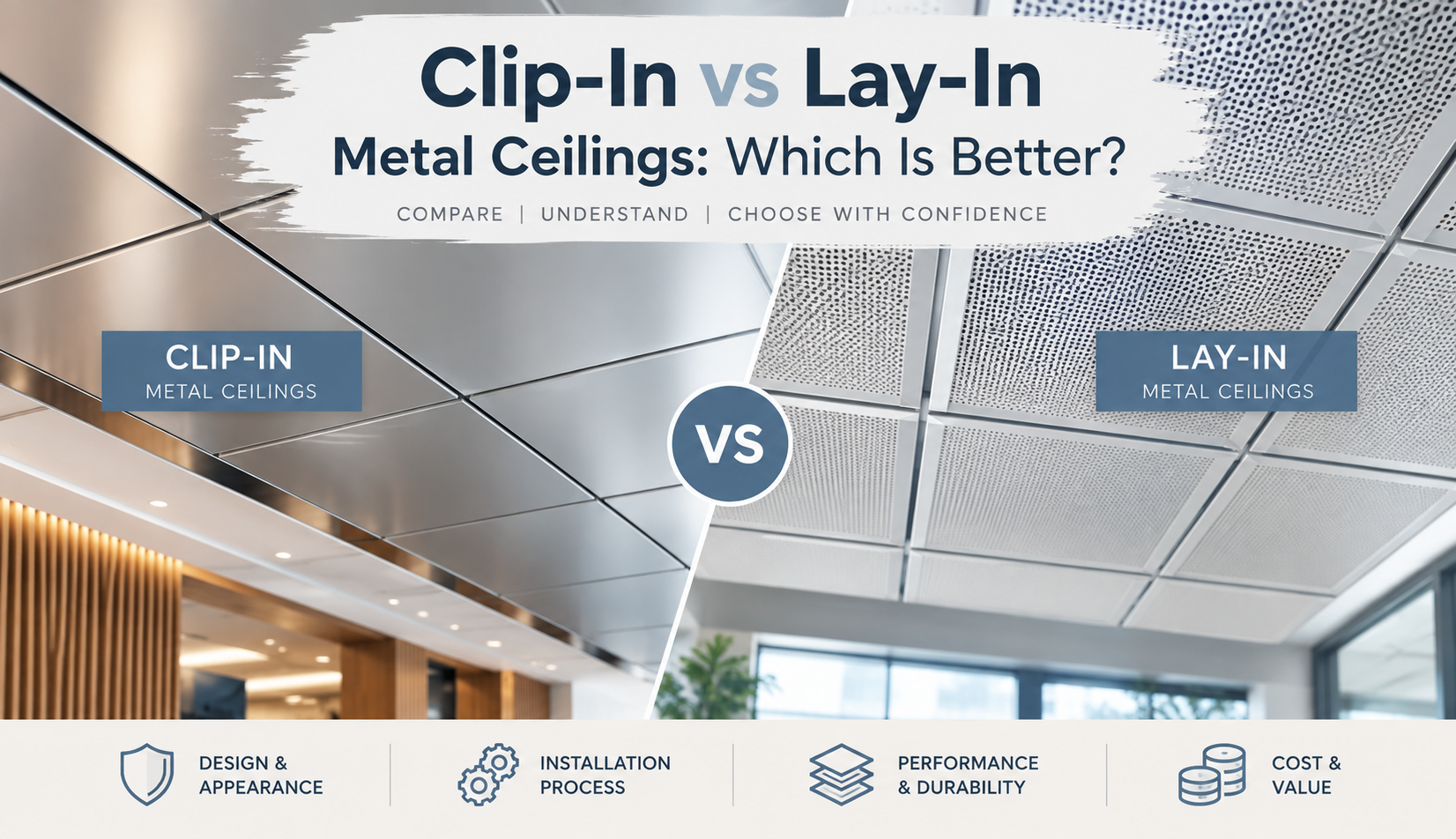
When choosing between Clip-In and Lay-In metal ceilings, there is no single system that is better for every project. A Clip-In Ceiling is generally suited to interiors that need a clean concealed appearance, secure panel retention and controlled ceiling access. A Lay In Ceiling is often preferred where easy access to services above the ceiling and straightforward installation are important.
Both are widely used types of metal ceiling systems for commercial and public buildings. The right choice depends on ceiling design, maintenance access, acoustic requirements, hygiene needs and the way building services are coordinated above the ceiling.
For architects, consultants and contractors, understanding these differences early can help avoid access problems, ceiling-detail changes and unnecessary compromises later in the project.
What Is a Clip-In Metal Ceiling?
A clip-in metal ceiling uses metal panels that connect securely to a concealed suspension system. Instead of simply resting on an exposed supporting grid, the panels are held in position by the suspension arrangement, producing a clean and continuous ceiling appearance.
USG ME Celebretto® Clip-In Metal Ceiling panels are designed for installation on Spring Tee ceiling suspensions. They are available in plain and perforated configurations, with different finishes and acoustic backing options.
One key characteristic of a Clip-In system is panel security. Because the tiles remain fixed in position, the ceiling can be suitable for spaces where uncontrolled access above the ceiling needs to be limited. Individual panels can still be removed when required using the appropriate extraction tool.
Key Features of a Clip-In Ceiling
- Concealed suspension appearance
- Securely retained metal panels
- Plain and perforated panel options
- Different colours and finishes
- Washable surface
- Acoustic backing options
- Controlled access to the ceiling void
- Suitable for interior and selected exterior applications
This combination makes Clip-In an effective durable ceiling system where appearance, hygiene and panel retention are important design considerations.
What Is a Lay-In Metal Ceiling?
A lay-in metal ceiling uses individual panels that rest directly on a supporting suspension grid. The tiles can therefore be lifted and removed relatively easily when access to the space above the ceiling is required.
USG ME Celebretto® Lay-In Metal Ceiling systems are designed for installation with DONN® or Quadra® ceiling suspension systems. The panels are available in different sizes, edge configurations, finishes and perforation patterns.
USG ME specifically identifies easy service access as one of the system's key benefits, making Lay-In particularly useful where mechanical, electrical or other services above the ceiling may need regular inspection or maintenance.
Key Features of a Lay-In Ceiling
- Straightforward panel installation
- Easy access to services above the ceiling
- Multiple sizes and edge configurations
- Plain and perforated options
- Washable polyester powder finish
- Acoustic-performance options
- Replaceable individual panels
- Suitable for a wide range of commercial interiors
For projects where maintenance teams regularly need access to the ceiling void, a Lay-In system can provide a practical balance between performance and accessibility.
Clip-In vs Lay-In Metal Ceiling: What Are the Main Differences?
The fundamental difference is how the panel connects to the suspension system.
Comparison Factor | Clip-In Metal Ceiling | Lay-In Metal Ceiling |
Panel installation | Panels clip into a concealed suspension system | Panels rest on a supporting grid |
Ceiling appearance | Clean, concealed suspension appearance | Modular ceiling appearance |
Access above ceiling | Controlled; panel removal requires the appropriate method/tool | Panels can be lifted for easier service access |
Panel security | Panels remain firmly retained | Panels rest within the suspension system |
Maintenance access | Better where access needs to be controlled | Better where frequent access is expected |
Hygiene considerations | Strong option where secure panels and cleanability are important | Washable and easy to maintain |
Acoustic options | Plain or perforated panels with acoustic backing options | Plain or perforated panels with acoustic options |
Typical design priority | Seamless appearance and secure retention | Accessibility and straightforward modular design |
The choice should therefore start with the operational needs of the space not simply the appearance of the ceiling.
Clip-In or Lay-In: Which Gives Better Ceiling Access?
For regular access to HVAC, electrical, fire-protection or other services in the ceiling void, Lay-In ceilings generally provide simpler access.
Because the panels rest on the suspension structure, individual tiles can be lifted when maintenance is required. USG ME specifically lists easy service maintenance as a feature of its Lay-In Metal Ceiling.
Clip-In panels are also removable, but their secure connection means access is more controlled. USG ME notes that its Clip-In panels are suitable where ceiling access needs to be limited and that an extraction tool is available for panel removal.
This makes the decision relatively straightforward:
Choose Lay-In when frequent access above the ceiling is a major operational requirement.
Consider Clip-In when a secure ceiling with controlled access is more important.
Which Metal Ceiling Creates a Cleaner Architectural Finish?
Clip-In systems are often selected when the design calls for a more continuous ceiling appearance.
Because the suspension arrangement is concealed behind the panels, the ceiling surface becomes the dominant visual element rather than the supporting grid. This can work well in commercial interiors where architects want a restrained, precise ceiling plane.
Lay-In ceilings create a more modular expression because the individual panels are supported within a grid-based system. This can be advantageous when repeatable modules need to coordinate efficiently with lighting, HVAC diffusers, sprinklers and other building services.
The better visual solution therefore depends on the architectural intent.
Use Clip-In where a concealed ceiling appearance is a priority. Use Lay-In where modularity and easy integration with accessible ceiling services are more important.
How Do Perforated Metal Ceilings Improve Acoustic Performance?
Both systems can form part of an acoustic metal ceiling when suitable perforated panels and acoustic backing materials are specified.
A perforated metal ceiling contains openings that allow sound energy to pass through the panel toward sound-absorbing material positioned behind it. The acoustic result depends on several factors, including the perforation pattern, open area, acoustic backing and complete ceiling assembly.
USG ME offers Clip-In metal ceiling systems with sound-absorbing backing options and states that configurations can achieve acoustic performance up to NRC 1.0 depending on the selected assembly. Lay-In products are also offered with perforation and sound-absorption options.
Therefore, neither installation format should automatically be assumed to have better acoustics.
For acoustic specification, evaluate:
- Required NRC or sound absorption
- Required CAC or sound attenuation
- Perforation pattern
- Acoustic backing material
- Ceiling plenum
- Room function
- Complete tested ceiling configuration
The acoustic requirement should be specified at system level rather than based only on whether the panel is Clip-In or Lay-In.
Which System Is Better for Cleaning and Hygiene?
Metal ceilings are commonly selected where durability and cleanability matter because their finished surfaces can be maintained more easily than many porous ceiling materials.
Both USG ME systems use durable, washable finishes and are described as robust and easy to clean.
Clip-In offers an additional advantage in applications where upward cleaning pressure could otherwise displace ceiling tiles. USG ME states that cleaning pressure can be applied upward without moving its Clip-In tiles, which supports its use in healthcare, hospital and food-production environments.
This does not mean Lay-In is unsuitable for these applications. Rather, hygiene requirements, access requirements and the complete ceiling specification should be considered together.
Where Are Clip-In Metal Ceilings Commonly Used?
Clip-In systems are particularly useful where a concealed appearance, robust panel retention or controlled ceiling access is required.
Typical applications include:
- Hospitals and healthcare facilities
- Airports and transportation buildings
- Educational facilities
- Commercial buildings
- Offices and high-rise developments
- Banking and financial interiors
- Shopping malls
- Kitchens and dietary areas
- Selected exterior applications
USG ME identifies these applications for its Celebretto® Clip-In system.
In UAE projects, the system can be especially relevant where designers need a combination of architectural finish, cleanability and long-term durability.
Where Are Lay-In Metal Ceilings Commonly Used?
Lay-In systems work well in interiors where ceiling accessibility and modular coordination are important.
Typical applications include:
- Airports and transportation facilities
- Schools and educational buildings
- Healthcare environments
- Commercial offices
- High-rise developments
- Banks
- Shopping malls
- Residential common areas
- Kitchens
- Laundry and utility rooms
USG ME lists these among the applications for its Lay-In system and highlights easy access for service maintenance as a key feature.
Where regular inspection of building services is expected, this accessibility can simplify long-term operation and maintenance.
Are Clip-In and Lay-In Ceilings Suitable for Suspended Ceiling Systems?
Yes. Both are forms of suspended metal ceiling construction, but they use different methods of supporting and retaining the panels.
In a Lay-In arrangement, panels rest on the suspension framework. In a Clip-In arrangement, panels engage with the supporting suspension system and remain more securely fixed.
This distinction affects:
- How the ceiling looks
- How panels are removed
- How often services can be accessed
- How maintenance is carried out
- How ceiling modules coordinate with other building services
The suspension system and panel should always be specified together rather than selecting the tile independently.
How to Choose Between Clip-In and Lay-In Metal Ceilings?
Before selecting either system, architects and project teams should answer several practical questions.
1. How often will the ceiling void need to be accessed?
If maintenance teams frequently need to reach mechanical or electrical services, a Lay-In system may simplify access.
2. Is a concealed ceiling appearance important?
If the project requires a clean surface with the supporting system hidden from view, Clip-In may better suit the design intent.
3. Does access need to be controlled?
Clip-In panels remain securely positioned and require deliberate removal, making them useful where uncontrolled access should be discouraged.
4. What acoustic performance does the space require?
Do not choose between Clip-In and Lay-In based on acoustics alone. Review perforation, acoustic backing and the complete tested assembly.
5. What are the hygiene and cleaning requirements?
Consider the expected cleaning method, frequency and operational conditions, particularly in healthcare, kitchens and other hygiene-sensitive spaces.
6. How will lighting and MEP services be coordinated?
The ceiling module should be coordinated early with lights, diffusers, sprinklers, detectors, access requirements and other ceiling-mounted services.
7. What finish and panel configuration does the design require?
Review panel dimensions, perforation patterns, colours, edge details and suspension compatibility before final specification.
Clip-In vs Lay-In Metal Ceilings: Which Is Better for Your Project?
Neither system is universally better.
Clip-In Metal Ceilings are better suited to projects that prioritise a concealed appearance, securely retained panels, controlled ceiling access and specific hygiene requirements.
Lay-In Metal Ceilings are better suited to projects that prioritise convenient service access, modular installation and straightforward panel removal.
For acoustic applications, both systems can be configured with perforated panels and appropriate sound-absorbing backing. For long-term durability, both provide robust and washable metal finishes.
The right decision therefore comes from matching the ceiling to the building's architecture, service-access strategy, acoustic criteria, cleaning requirements and maintenance plan.
USG ME's Celebretto® range provides both Clip-In and Lay-In options, allowing project teams to choose the system configuration that best matches the functional and design requirements of the space.
Frequently Asked Questions About Clip-In and Lay-In Metal Ceilings
What is the main difference between Clip-In and Lay-In ceilings?
Clip-In panels connect securely to a concealed suspension system, while Lay-In panels rest on the supporting ceiling grid. This makes Lay-In panels easier to lift for routine service access, while Clip-In panels provide more controlled removal.
Is a Clip-In ceiling better than a Lay-In ceiling?
Not in every application. Clip-In is more appropriate when concealed appearance and secure panel retention are priorities. Lay-In is more appropriate where easy and frequent access above the ceiling is required.
Can Clip-In and Lay-In ceilings be perforated?
Yes. USG ME offers both systems with perforation options. Perforated panels can be combined with acoustic backing to improve sound absorption.
Which metal ceiling is easier to maintain?
Both systems have durable, washable finishes. Lay-In provides easier access to the ceiling void for service maintenance, while Clip-In offers securely retained panels and controlled removal.
Which ceiling is suitable for hospitals?
Both can be used in healthcare applications. Clip-In can offer additional advantages where secure panel retention and cleaning requirements are important, while the final selection should follow the project's hygiene, acoustic and maintenance criteria.
Are metal ceilings suitable for UAE commercial projects?
Metal ceiling systems can be used across airports, healthcare facilities, offices, schools, retail spaces and other commercial developments. The correct system should be selected according to the project's environmental conditions, ceiling design and performance specification.