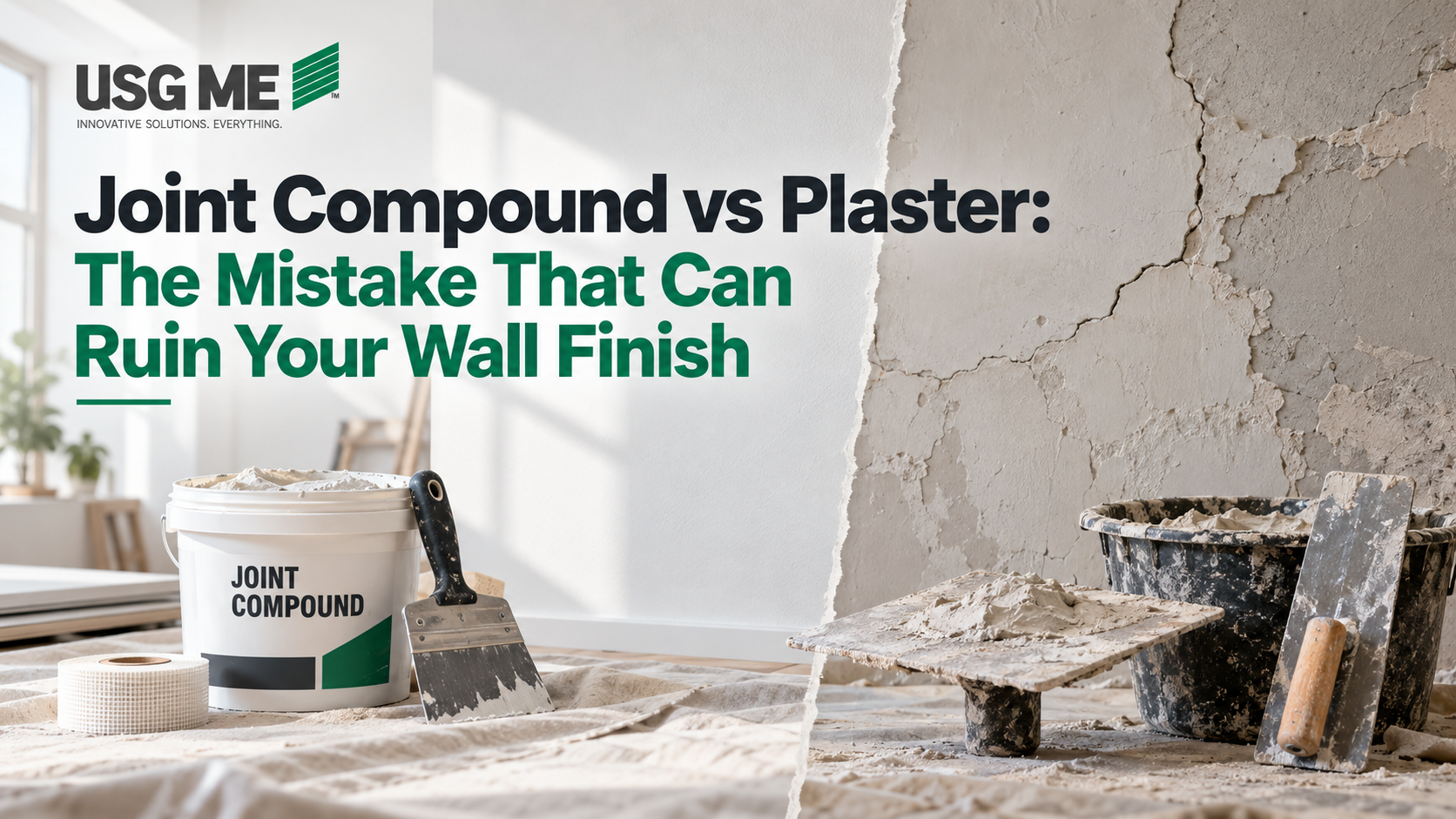
Using plaster and joint compound as if they are interchangeable can lead to cracking, poor adhesion, uneven surfaces, difficult sanding, and unnecessary rework. Both materials are used to create smoother interior finishes, but they are formulated for different substrates, applications, and stages of construction.
For drywall projects in the UAE, the correct product depends on whether the work involves finishing gypsum board joints, skimming a drywall surface, repairing concrete, or applying a specialist plaster finish. USG ME separates these functions across joint compounds, cement-surface finishing products, and specialised spray-applied ceiling finishes.
Understanding the difference before work begins can help contractors and consultants avoid a finish that looks acceptable initially but develops problems later.
What Is Joint Compound and Where Should It Be Used?
A gypsum joint compound is primarily designed to treat joints between gypsum boards and prepare drywall surfaces for decoration. USG ME’s Sheetrock® All Purpose Joint Compound and Premium Premix are designed for tasks such as:
- Embedding joint tape
- Filling gypsum board joints
- Covering fastener heads
- Treating internal angles
- Skim coating
- Preparing surfaces for paint
USG ME states that its conventional joint-compound range includes ready-mixed, powder, and setting-type options for jointing, skimming, texturing, and Level 5 finishing. Several products comply with ASTM C475. The important point is that joint compound is part of a drywall finishing system. It should be selected according to the board, tape, finish level, and intended application.
What Is Plaster and How Is It Different from Joint Compounds?
Plaster is a broader category of finishing material and can be formulated for different substrates and systems.
Depending on the product, plaster may be used to:
- Finish masonry or concrete
- Create thicker levelling coats
- Form decorative surfaces
- Produce specialised ceiling finishes
- Work as part of a cementitious or gypsum-based system
USG ME’s products demonstrate this distinction clearly. Sheetrock® Base Compound is formulated for interior cement and fibre-cement applications and for finishing concrete substrates. By contrast, MAC Plaster Spray Applied Finish is a fine-textured specialist finish intended specifically for the MAC Acoustical Plasterboard Ceiling..
That means the term “plaster” alone is not enough to specify a material correctly. The substrate and system matter.
Joint Compound vs Plaster: What Is the Main Difference?
The biggest difference is what the material is designed to do.
Factor | Joint Compound | Plaster |
Primary use | Drywall jointing, taping, skimming, finishing | Surface levelling or specialist plaster finishes |
Common substrate | Gypsum board | Depends on product: concrete, masonry, gypsum systems or specialist ceilings |
Application thickness | Generally thin finishing coats | Can vary significantly by plaster system |
Sanding | Many joint compounds are designed for easy sanding | Depends on plaster formulation |
Joint tape | Commonly used with drywall tape | Not automatically part of the system |
Finish process | Multi-coat drywall finishing | Product-specific |
Main risk if misused | Cracking, weak joints, poor finish | Poor adhesion or incompatibility with substrate/system |
This is why choosing based only on texture or appearance can create problems.
Mistake 1: Using Plaster Instead of Joint Compound on Gypsum Board Joints
Gypsum board joints move differently from monolithic plaster surfaces. Board joints require reinforcement because the edges of two separate panels meet at the joint. USG ME’s drywall finishing systems use joint tape together with compatible compounds to reinforce these areas.
Applying an unsuitable plaster directly over board joints may not provide the same reinforcement strategy.
This can contribute to:
- Hairline cracking
- Visible joints
- Joint separation
- Uneven finishes
Better approach
Use the specified joint tape and joint compound system for gypsum board joints. Treat plaster as a separate finishing material unless the approved system specifically states otherwise.
Mistake 2: Using Joint Compound on the Wrong Substrate
Joint compound is versatile, but it should not automatically be applied to every wall surface. USG ME separates gypsum finishing products from cement-surface finishing solutions. Sheetrock® Base Compound, for example, is specifically formulated for concrete and fibre-cement substrates. Applying ordinary drywall compound to a surface that requires a different formulation may affect adhesion or long-term performance.
Better approach
Identify the substrate first:
- Gypsum board
- Concrete
- Cement board
- Masonry
- Acoustic plasterboard
- Existing plaster
Then choose a product intended for that material.
Mistake 3: Assuming All Joint Compounds Work the Same Way
There are different types of joint compound.
USG ME currently offers:
- Ready-mixed compounds
- Powder drying-type compounds
- Setting-type jointing compounds
- Level 5 primer-surfacers
EASYJOINT™ 60, for example, is a plaster-based setting compound with a controlled setting time of approximately 60 minutes, while Premium Premix and Sheetrock® All Purpose Joint Compound are air-drying products.
The working method, drying time, sanding, and application sequence can therefore differ.
Better approach
Choose the compound based on:
- Taping
- Bedding
- Filling
- Skimming
- Finishing
- Required working time
- Level of finish
Do not treat every bucket or bag of compound as an identical product.
Mistake 4: Using a Ceiling Joint Compound Without Checking the Ceiling System
A ceiling joint compound should be selected as part of the ceiling system, particularly when gypsum boards form a continuous ceiling surface. A standard gypsum ceiling may require conventional jointing and finishing. A specialist acoustic system may need a very different approach.
USG ME’s MAC Plaster Spray Applied Finish is a good example. It is designed only for the MAC Acoustical Plasterboard Ceiling and is described as acoustically transparent. USG ME also warns that painting this finish can negatively affect acoustic performance.
Better approach
Before finishing a ceiling, determine:
- Is it ordinary gypsum board?
- Is it perforated?
- Is it an acoustic system?
- Is a proprietary finish required?
- Will the surface be painted?
This prevents a finishing product from unintentionally changing system performance.
Mistake 5: Treating Spray Plaster as a General-Purpose Finish
Spray plaster can be efficient, but that does not mean every spray-applied product can be used everywhere. USG ME’s MAC Plaster Spray Applied Finish requires pneumatic spray equipment and is specifically designed for its acoustic plasterboard ceiling. It is not intended for surfaces subject to regular contact.
Using such a product outside its intended system can result in poor durability or compromised performance.
Better approach
Check the technical datasheet for:
- Approved substrate
- Application equipment
- Recoat time
- Contact limitations
- Paint compatibility
- Acoustic requirements
A specialist spray finish should remain part of the tested or specified system.
Mistake 6: Ignoring Drywall Accessories During Joint Finishing
A smooth wall depends on more than compound. Drywall accessories such as joint tape, corner beads, trims, and fasteners influence how joints, corners, and edges perform. USG ME describes paper joint tape as a reinforcing component used with joint compounds to strengthen gypsum drywall joints and corners.
If installers use the right compound but omit or incorrectly install supporting accessories, the finish can still fail.
Better approach
Coordinate:
- Joint tape
- Corner beads
- Trims
- Fasteners
- Joint compound
- Sanding and finishing sequence
Treat them as one finishing system.
Mistake 7: Using Wall-Finishing Products Around the Wrong Ceiling Type
The target surface matters. A gypsum board ceiling may need tape, compound, and surface finishing. A metal ceiling, however, is a prefabricated panel system and does not use drywall joint compound across the visible surface.
Likewise, a modular suspended ceiling may use removable tiles rather than a monolithic jointed finish. Using drywall finishing logic on a ceiling system that is not drywall can create unnecessary specification confusion.
Better approach
Identify the ceiling construction first:
- Gypsum board
- Modular gypsum tile
- Metal panel
- Acoustic plasterboard
- Mineral fibre
- Specialty acoustic system
Then specify finishes and Ceiling accessories that belong to that system.
Which Material Should You Use for Gypsum Board Finishing?
For standard gypsum board interiors, joint compound is generally the correct material for treating board joints, corners, and fastener heads. USG ME’s Sheetrock® All Purpose Joint Compound is designed for all three coats or as a finishing coat over plasterboard joints. Premium Premix provides another ready-mixed option with low shrinkage and easy sanding.
A typical finishing sequence may include:
- Embed joint tape.
- Apply the first coat.
- Apply progressively wider finishing coats.
- Allow drying as specified.
- Sand where required.
- Prime and decorate.
The exact process should follow the selected system and product documentation.
When Is Plaster the Better Choice?
Plaster may be more appropriate when the project involves:
- Concrete surfaces
- Cement-based substrates
- Specialist acoustic finishes
- Thicker levelling requirements
- Product-specific plaster systems
For example, USG ME’s Sheetrock® Base Compound is designed for concrete substrate finishing, while MAC Spray Applied Finish is intended for a specialist acoustic ceiling application. The key is to match the material to its intended substrate.
Joint Compound vs Plaster Selection Checklist
Before choosing either material, ask:
- What is the substrate?
- Is the surface gypsum board, concrete, or cement board?
- Are board joints being treated?
- Is joint tape required?
- Is the work for skimming or levelling?
- Is the application wall or ceiling?
- Is it an acoustic ceiling system?
- Does the finish need sanding?
- What drying or setting time is required?
- Is painting planned?
- Does the manufacturer specify a proprietary finish?
Answering these questions is more reliable than selecting a product simply because it looks similar to another finishing material.
FAQs About Joint Compound vs Plaster
Is Joint Compound the Same as Plaster?
No. Joint compound is primarily used for drywall joint treatment, taping, skimming, and finishing. Plaster covers a broader range of surface-finishing materials and may be formulated for different substrates and applications.
Can Joint Compound Be Used to Skim a Wall?
Yes. Selected joint compounds are suitable for skim coating. USG ME lists skimming as an application for several of its conventional joint compounds.
Can Plaster Be Used on Gypsum Board Joints?
Only when the specified plaster system is designed for that application. Standard gypsum board joints are normally treated using compatible joint tape and joint compound.
What Is Gypsum Joint Compound Used For?
It is used to embed joint tape, fill joints, cover fasteners and angles, skim surfaces, and prepare gypsum board for decoration.
Is Spray Plaster Suitable for Every Ceiling?
No. Spray-applied plaster products can be system-specific. USG ME's MAC Spray Applied Finish, for example, is specifically designed for MAC Acoustical Plasterboard Ceilings.
Can Joint Compound Be Used on a Metal Ceiling?
No. Metal ceilings are finished panel systems and do not use drywall joint compound across their visible panel surfaces.
Why Do Drywall Joints Crack After Finishing?
Possible causes include poor joint reinforcement, incorrect compound selection, movement, inadequate drying, or improper installation. The joint tape, compound, board, and framing should work as a complete system.